

Eva Albalghiti | Spotlight | On socially engaged design in environmental engineering
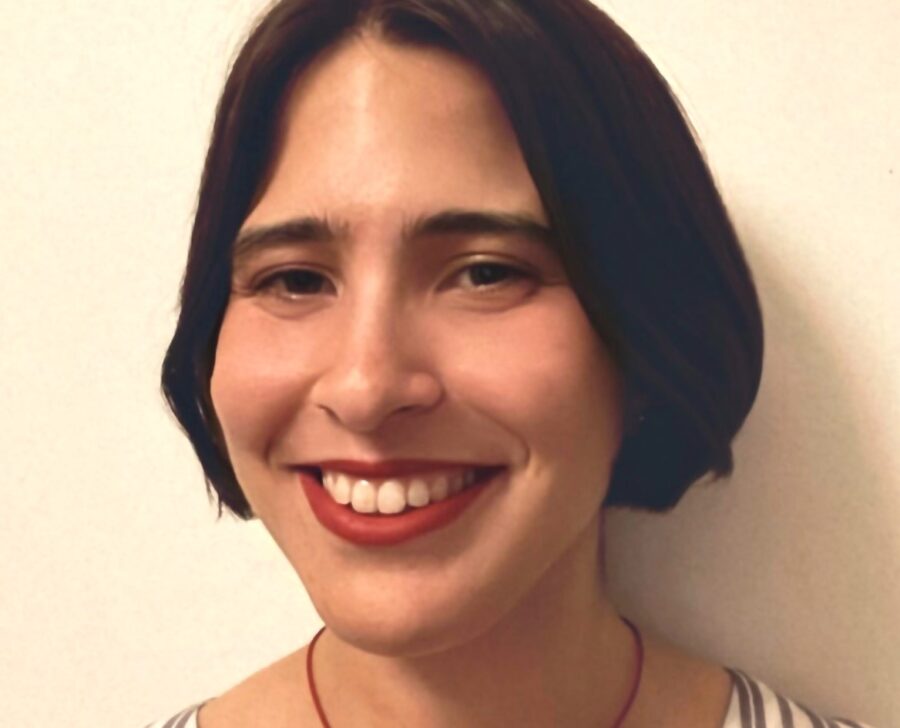
Eva Albalghiti, a former Graduate Facilitator at the Center for Socially Engaged Engineering & Design, earned a PhD in Environmental Engineering in May 2026.
Before moving on to new opportunities, she met with Storyteller Malin Andersson-Williams to discuss how she found her way to C-SED, share insight into her research, and expand on what influences her as a person and a designer.
What brought you to C-SED?
[Albalghiti] I first engaged with C-SED in the Fall of 2022 when I began working on a project through the Community Engagement and Empowerment Committee to write case studies for C-SED workshops that are specifically relevant to civil and environmental engineering. Since I’m interested in teaching and curriculum development more broadly, I thought it was a great opportunity to further develop that skill set.
Sara Hoffman guided us through developing case studies for particular instructors’ classes, which was a rewarding process. It was definitely a different way of thinking from what I typically exercise in my research, and I learned a lot.
Ultimately, that work did generate a case study, which we’ve done a couple of times now, and the experience of facilitating that case study got me thinking about the bigger picture of what is missing from engineering education. I also felt like our department would benefit from engaging more with C-SED — I think they bring something that really enriches the engineering curriculum.
So for all those reasons, I stayed on as a graduate facilitator for my last two years of grad school, and I feel so fortunate to have found that community. Along the way, I feel like I’ve learned so much from my fellow facilitators about how we can continue to bring these two worlds together – the technical side and the social implications of engineering decisions.
Which case studies were you involved in developing? And second, which sessions were especially interesting to you as a Graduate Facilitator?
I’ve only had a hand in writing the case study about Detroit’s I-375 reconstruction project, which I helped to develop with Sara Hoffman and Atiyya Shaw, who is a professor in our department. I knew nothing about infrastructure going in, so I would have been totally lost without Atiyya’s expertise and Sara’s experience in this kind of research and writing. I especially enjoyed getting to dive into the primary sources around this particular sociotechnical challenge, since it’s something that’s playing out right now in our backyard.
As a facilitator, I like pretty much everything we do, but I especially enjoy the case studies because they allow me to flex my engineering brain and learn about something that’s outside my discipline while also connecting it to a broader picture.
The case studies I’ve particularly appreciated are the ones that are closest to my department’s area of interest. I like the Hurricane Katrina one a lot. Obviously, natural disaster readiness and response will only get more relevant as we feel the effects of climate change more and more, and our ability to rise to this challenge as a society is tied up in how unequally the risks and burdens of climate change are distributed. I especially enjoy facilitating that one in Civil & Environmental Engineering (CEE) classrooms because often the instructors or the students will have personal experience or expertise that they can contribute, and I think it just makes everyone extra engaged.
I also recently got to facilitate a new case study on PFAS, co-developed by our case writers and Aleksandra Szczuka, a professor in our department. One thing I liked about that experience was that the case was developed with a particular course in mind, so it integrates seamlessly.
Also, a shoutout to the Big Winds case study! It’s one of our mainstays for a reason.
Outside of C-SED, what are you working on? Can you tell me a little bit about your research?
I’m on the environmental side of civil and environmental engineering, and I specifically study the subsurface — basically everything beneath our feet, from a few inches to a few miles below ground. I often introduce my research with a statement that I had literally never thought about before I started working on this: the subsurface is a porous medium. If I were to start digging somewhere in Ann Arbor, I’d dig through a dirt layer, and then some layers of sand and silt and gravel. We understand that these are porous media because we’ve probably seen a gravel filter, or water percolating through sand at the beach. But eventually I’d hit bedrock, and many rocks are porous too — they’re full of empty space. And it’s from this space that we get things like groundwater, oil, and natural gas, and we can also take advantage of these spaces to store things like carbon dioxide and hydrogen.
So, how fluids move through these pore spaces is important to understand because it has implications for water resources, contaminant remediation, and energy systems, to name a few. It can also get pretty complicated, especially if you’re talking about engineering fluid flow, and it requires some cross-disciplinary work that might incorporate some physics, some chemistry, and some biology. My dissertation answers a few of these fundamental questions about engineering fluid flow in the subsurface, specifically through a process that uses microorganisms to precipitate minerals. So basically, I have some bacteria acting like a microscopic construction crew, making new rock in existing flow paths in order to change the overall flow field —but they don’t like being told what to do, and their behavior is not easy to predict in complex porous media like natural rocks and sediments.
How does socially engaged engineering & design intersect with your work?
In the field of environmental engineering, it’s probably more intuitive than in other disciplines to incorporate the work that C-SED does. I think C-SED’s work is inherently relevant to my research, because benefit to society should always inform our research questions and goals. I hope that what I learned at C-SED will give me the tools that I need to start tackling something that’s a little bit more socially interfacing.
What is the value of a socially engaged design approach in environmental and civil engineering?
Environmental engineers as a community are having to contend with a perceived gap between the science that we do and the benefit that people see. So given these society-level challenges to science, and to anything with the word “environmental” in it, the field is going to have to evolve in some way to meet those challenges. That’s not a bad thing, or even a new thing — what we do is always changing. We don’t do research the same way that we used to in 1960, 1980, or 2000, because we adapt to what is technically feasible, what is economically feasible, and what is a societal priority.
Focusing on being responsive to community needs seems like it could open up new modes of inquiry, new collaborations, and potentially even new funding streams. It’s not just something you do because you want to help people — although that’s a good reason to do things — it’s an opportunity, and it could take your work to places that it otherwise might not go.
Can you describe a past project that has impacted you as a designer, facilitator, and/or researcher?
The I-375 workshop I mentioned has really informed what I pay attention to in environmental engineering. It’s a civil engineering problem, usually, that we talk about when we talk about highways, but there’s a whole branch of environmental engineering that centers on the built environment and the environments we create for ourselves. In looking at materials for that workshop, I think it opened up a whole new section of my field to me that I wouldn’t have otherwise been aware of.
I’m hoping that in the future, I can branch into infrastructure and the built environment and apply what I know about materials and the basic physics of fluid flow to this area that I find exciting and important. Maybe by being a creative experimentalist, I can contribute to the work that modelers and other experimentalists do to try to help folks bring these ideas towards implementation.
Looking ahead, what would you like to do? What do you envision for yourself?
In grad school, I’ve gotten to do a lot of research and a fair amount of teaching, and I like both of those things a lot. So I’d like to be a professor, if I can make it happen, since combining these two practices seems like a good way for me to have a positive impact on the world. The ability to support people in reaching something that you can’t even envision is immensely rewarding.
As for what kind of research or what kind of teaching I want to do, I do hope to be at least somewhat grounded in a local community or set of needs. I want my research and my teaching to make sense with the people and places around me. That’s an important way that I stay motivated. As I mentioned, there are definitely folks who are already doing this to different degrees, but it’s not something I’ve personally delved into yet.
How has the experience of facilitating developed your ability to teach? How has it helped you shift and develop your approach to teaching and education?
Being a facilitator has definitely made me a stronger teacher, but not in the way I would have expected. Understanding what your value-add is or what your role is can be difficult. You’re there to facilitate students coming to their own interpretation and synthesis of what they already know or are learning, with this bigger-picture societal piece they might not have considered yet.
It’s also a different level of control that you have over the classroom. As facilitators, we’re ultimately guests. Sometimes, the instructor or GSI is really involved, and they’ve primed the students to integrate the session with what students are learning in the class. But that’s not necessarily the case, so the biggest skill set that facilitators need to cultivate is adaptability and being able to read the room quickly, to respond dynamically to students’ questions and concerns or even non-verbal cues. You’re here with content that you need to deliver, but you also want to connect with students genuinely. To do that, you have to have unrehearsed conversations with students, even when the subject isn’t something you’re an expert in. That can be intimidating at first, but it’s empowering to really know what you know and what you don’t know, and to fully own both of those.
How would you approach a classroom of your own?
Building in interactive moments is something I’ll be exploring as an instructor, and like many good teaching practices, it’ll probably be a process. If we want to build a discussion of how the social and technical dimensions interact, we’ll probably have to start with making engineering classrooms more interactive than they currently are. I’ve seen that done, but it is a lot of work.
But with that foundation, I think it becomes easier to have conversations about the broader context in which engineering is happening. If students are already talking to each other, and they’re already talking to you, then they’re already accustomed to this idea that there’s not always a single answer that the instructor is trying to get them to say it. Sometimes, it’s a genuine gray area, and we’re genuinely talking it out.
When we talk about expanding the scope of the curriculum, there’s also a time constraint piece. There are only so many class hours in a semester, and so I think a lot of people have come to believe that it’s not possible to transmit all of the fundamental understanding that we need to get across in an engineering curriculum, while also having these more interactive, discussion moments. But I don’t think it’s impossible. It’ll probably just be hard.