

Nolgie Oquendo-Colón | Spotlight | On facilitation and engineering education research
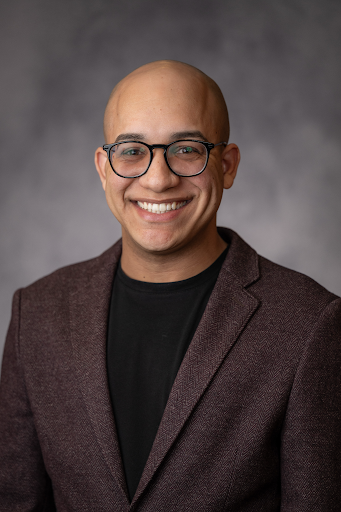
Nolgie Oquendo-Colón, PhD Candidate in Engineering Education Research at the College of Engineering, is passionate about utilizing his perspective in Industrial & Operations Engineering to address how education can more effectively prepare engineering students for their careers.
A Graduate Facilitator at the Center for Socially Engaged Engineering & Design, Nolgie is inspired by the creativity of students, his colleagues, and his own curiosity in his search for supportive education and pedagogy.
Recently, Nolgie met with Storyteller Malin Andersson-Williams to discuss how he became involved with C-SED, share some insight into his research on the impacts of teaching practices on engineering students with ADHD, and expand on what influences him as a person and a designer.
What brought you to C-SED?
[Oquendo-Colón] I joined C-SED in 2024 at the encouragement of another facilitator, Betsy Strehl, to help get more teaching experience.
I shared with her my own research into neurodivergent students’ experiences and instructional practices, and their impact on classroom experiences. I mentioned that I’d love to be on the other side of the classroom as a teacher to see how that firsthand experience might influence my analytical lens as a researcher. That’s when she said, “You know what? Maybe you would like to work at C-SED!”
As we are both part of the Engineering Education Research program, we shared a mutual interest in teaching engineering and understanding how it might inform our respective research. The more Betsy told me about C-SED’s goals, the more I found myself drawn to it. I asked her questions, read a little more on my own, and I think I fell in love with it. I was very interested in being part of that type of community. And… here I am!
Before you came to C-SED, was socially engaged engineering & design already present in your work? How did it develop?
It developed gradually. When I started my Master’s and found engineering education, I began thinking seriously for the first time about how engineering decisions impact society at large; that’s really where it started for me. I read more about socially engaged design, design thinking models, and how engineering knowledge itself can be shaped by societal implications.
But it wasn’t something I had the tools for earlier on. In undergrad, even when we had instructors who talked about socially engaged design, we didn’t have the tools to actually work with it or bring it into our own work. That’s part of why I talk so much about how lucky students at Michigan are to have C-SED: we don’t just create specific case studies to dig into the technical side; we also show how to apply socially engaged design principles throughout the whole lifecycle of a project. That combination of technical grounding plus the tools to act on the social dimension was what I felt was missing earlier in my own training.
When you first encountered this socially engaged approach, what value did you see in it? What motivated you to engage with it further?
All engineering problems are more complex than we think they are. Usually, engineers are given a problem, and then we are asked to develop a solution. So we dig into the technical knowledge first, then try to build something, test it, and see if it works. But too often, we stop there. I was trained to focus on the solution and deliver it, but what is done with the solution afterwards was another person’s problem.
But what happens to the people involved in that process? When you think more about socially engaged design, you start asking, “Did I take this factor or stakeholder into consideration? What will happen to them if we implement this? What will happen to the people who are replaced by this product?”
Everything we decide as engineers will ultimately impact people. At the time, I wasn’t thinking about it. But once I started understanding socially engaged design, I started asking how we can meaningfully make change and contribute to society positively prior to deploying and implementing a solution.
What drew you to engineering education?
By my senior year as an undergrad, I was working a year-long co-op, which was a good experience overall, but felt like it was missing something. I missed being in a lab, working with a mentor, being around students, and seeing what others were building and discovering. That pull back toward an academic environment got me thinking more broadly. From my Industrial and Operations Engineering (IOE) perspective, I started noticing how much we’re trained to systematically solve problems in industry, yet we still have real, unaddressed problems in how we teach engineering itself. No one seemed to be working on changing that… yet.
Around that same time, one of my mentors encouraged me to read more about engineering education as a field. The more familiar I became with the field, the more I realized I could contribute by asking how we can improve the way we teach engineering, how we can get students more interested in it, and, given everything happening right now, what the engineer of the future might even look like.
What is a project or experience that impacted your process as a designer, facilitator, or educator?
I think my own work has changed the way I approach teaching and research. My dissertation focuses on the role of instructional practices in the experiences of college students with ADHD, specifically in engineering.
Now, whenever I sit down to read a syllabus or write a teaching statement, I’m actively thinking of what I have learned from students and faculty who have engaged with my research. I’ve been incorporating this work in my own teaching practice by asking how I can be more effective and more supportive of my students, by not ignoring their strengths and their needs, but by incorporating them into class.
What is the value in integrating both social and technical considerations in the classroom?
If you want to be a good engineer, you have to think about people. We actually see this play out with our students. Those who’ve taken C-SED workshops before come into discussions with more elaborate, more nuanced arguments; they’re able to hold the technical and social considerations together, rather than treating them as separate conversations. It’s not about adding “soft skills” on top of engineering; it’s about training a different, more complete kind of engineering judgment from the start. And I think that’s the value that C-SED adds to the engineering community.
What is a current project or experience that is inspiring you as a designer, a facilitator, an instructor, or as an individual?
Right now, it’s analyzing the data in my dissertation. I ran focus groups to understand how different teaching practices shape neurodivergent students’ classroom experiences, academic adjustment, and sense of belonging in engineering, and now I’m deep in analyzing what students told me.
What’s been inspiring is going back through those interviews and focus groups and seeing, in students’ own words, how a single instructional choice can ripple out into something bigger, into whether a student feels equipped to handle the academic transition into engineering, or whether they feel like they belong in the field at all. It’s one thing to hypothesize that connection; it’s another to read a student describe it happening to them in real time.
Which case studies or design sessions have you particularly enjoyed as a Graduate Facilitator?
From the design skills sessions, I think prototyping and stakeholder mapping are my favorites because you learn with students, and it’s really interactive.
For case studies, Hurricane Katrina is really good. The way that C-SED case writers prepared the material for us, we learned so much before explaining to students what’s going on, how big the problem was, and how difficult the problem was. The Xbox Adaptive Controller is one of my favorites, too. Students get to explore their own way of thinking and then see how that differs from their peers who are in the same room with the same information. It’s a good way to tell them how we can all have the same information, but take different approaches because we have different priorities.
What have you enjoyed about being with C-SED? What have you enjoyed about being a graduate facilitator?
Interacting with the students, working with them, and helping them through their thinking process is really cool. I also have to say that working with my colleagues who are also graduate facilitators is great. You get to know a lot of good people, and you end up working together. We mix and match with different sessions, and learn from each other in the way we teach. We learn a lot, and it’s a very good community that we have developed.
The C-SED Staff, also. They listen to us and involve us in everything. When they pilot a new case study, they ask us for our feedback and what we think. They really care about what we do, and you feel part of the team from the first day forward.
You can connect with Nolgie via his LinkedIn to discuss his research on the experience of neurodivergent students in engineering, teaching and learning, and instructional innovation.