

Peter Fabe | Staff Spotlight | On Socially Engaged Engineering

C-SED Lab Staff, Peter Fabe, is pursuing his PhD in Design Science at the College of Engineering. In August 2026, Peter will begin working at McMaster-Carr in Cleveland.
Recently, he met with Storyteller Malin Andersson-Williams to discuss how he found his way to the C-SED Lab, share insight into his ongoing socially engaged engineering projects, and expand on what has impacted him as a person and a designer.
What brought you to C-SED?
Two things! Before I came here, I worked for a very similar center at the University of Dayton called the ETHOS Center, connecting engineering students with socio-technical humanitarian learning opportunities. I heard about C-SED when I came to visit U-M and said, “This sounds like the place I’m a graduate assistant for now!”
When I came in as a Design Science PhD student, I wanted to get involved with C-SED, so when Charlie Michaels, Managing Director of the Center for Socially Engaged Design, was our instructor for the Design Science Seminar, I knew I wanted to talk with him.
We met, and I shared my experience as a graduate student for 2 years at the University of Dayton, teaching community-engaged design and systems thinking, and helping prep students to go all over the world to use their engineering skills to serve community partners. That’s when Charlie told me about C-SED’s makerspace and encouraged me to apply.

Peter standing next to statue of himself holding his daughter made out of recycled plastic on North Campus Diag
When you started working with the makerspace and the lab, what did you find particularly interesting or exciting?
When I came in, it [the C-SED Lab] felt like a wood shop – with a little more stuff. Wood definitely seemed to be the focus. Charlie said that he wanted to grow 3D printing at C-SED, and my background is entirely in 3D printing! I’ve been doing 3D printing of various forms for the past decade of my life. I have spent 6 months in Southeast India building a 3D printer that prints houses; I worked for an Air Force contractor that built 3D printers that printed titanium super alloys for aerospace and defense; and my work is actually in recycled plastic 3D printing, taking spoons, forks, and knives from the dining halls, and turning them into 3D printing material.
So I talked with Charlie and encouraged him to get three new 3D printers and just see how they go. And now we have eight!
It was such a positive experience that after my first semester working with them, we got more. Students really dug into it! The printers were just so easy to use, the maintenance was great, and they were really reliable.
Everybody on staff has a specialty area – some people are good at wood, some people are really good at sewing, and some at embroidery and crocheting. 3D printing was the thing that I brought, and I’m very lucky that Charlie trusted me and said, ” Let’s make it happen.” It’s continued to be fruitful. That’s one of the things I’m most proud of: growing the 3D printing capacity in the lab. Getting students that hands-on access is something that I’m really happy about.
When you think back to your time in the lab, are there any projects that stuck out to you? Anything you helped out with that was especially engaging?
Just being able to help people with whatever they brought in that day. I remember how it was to not know how to use any of this, and so helping students cross over that barrier and be able to use a tool to make the stuff that they think of in their mind has been really rewarding.
I’ve had, for example, a recurring student in kinesiology who didn’t have an engineering background but wanted to develop a better low-cost prosthetic hand. For every week of an entire semester, he would come talk to me about design; I would help him with mechanisms, and we’d think about how to build it and make it low-cost. That’s been particularly special to me because it went on for a very long time.
Is there anything you wish more people understood about the C-SED Lab?
It’s for everybody. You don’t have to know what you’re doing to enter the space. I feel like people are afraid to come into makerspaces because they don’t know how to make anything. It doesn’t matter!
Even if you don’t know what you want to make, and you just want to learn what a tool is and how to use it – come learn the tool! We will show you – probably more than you want to know. Once you pick what it is in particular that you want to know, we’ll work with you.

Peter recycling plastic cups into new 3D printing filament
Tell me about your work outside of CSED
I’m a PhD student in Design Science where we study how human beings interact with stuff and how we can make stuff better for the way human beings interact with it – products, systems, services, software, all of it. Most of my work falls in the domain of sustainable additive manufacturing and manufacturing education.
I have always loved physical products, and I came into engineering wanting to design physical products. My work outside of that has been both doing research in additive manufacturing and 3D printing – how it is that we make stuff with 3D printers, how we can make it more sustainable or better, how we can be better with our material utilization, how we could be better with our production of the actual pieces, and how we can design better.
The other part is teaching others to use 3D printing as a medium for design. I was the GSI for the Design and Manufacturing course here for sophomore mechanical engineering students for two semesters and brought 3D printing into that curriculum. Prior to that, they just used mills and lathes, which are giant, manual machines, but I was able to bring 3D printers into the course and further the curriculum.
I’m really passionate about teaching other people how to make stuff, how to do it well and meaningfully, and how to get something from your head into reality in a way that requires the least amount of work or effort on your part. It is empowering to be able to take something in your mind and make it in reality.

CAD model of the controller project in ENGR 100 to upskill first-year engineering students
Tell me about the Adaptive Gaming section of Engineering 100 this semester
This past semester, I got the chance to be the GSI for a section of a first-year engineering design course, Engineering 100, with Charlie, and our theme was Adaptive Video Gaming.
Every single student learned all of the necessary skills that they needed to physically fabricate a video game controller, essentially from scratch. The case is 3D printed, and the students do all of the wiring on the inside themselves, learning how to solder, use AI to help them program, and how to use CAD software to take a 3D digital design out of the virtual and into the physical with 3D printing.
I think people underestimate what first-year students are capable of learning in a short time. I was not surprised by what they were able to do, but I was very proud of the work that they put in. I think that we gave them the right amount of support to let them explore, learn, and build. It’s given them this general skill set that, no matter what discipline they choose, will serve them and allow them to talk to designers across fields.
What surprised you during Engineering 100 and Adaptive Gaming?
One of the big findings in the course came from this one time: there was a group of students who just seemed stuck with the file on their computer, so I went over to check in, and they said, “We don’t know how to get a file on an SD card.” Because they’re the Chromebook generation, they’ve never had to deal with physical files before.
How such a small procedural barrier stops people from engaging with an otherwise successful technology is something that I keep at the forefront of everything I do now. It’s little things like that where you need to find what’s preventing people from engaging with stuff. Since you’ve spent enough time with it, you don’t even think about that relationship anymore.
That was a really fun finding that sticks with me. How do I identify these little procedural barriers that, to somebody who’s just beginning, can completely derail them from using something that would have otherwise been really enabling for them?
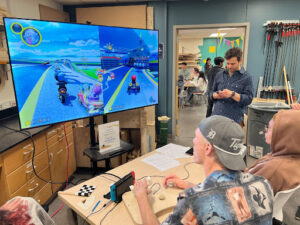
Adaptive controllers in ENGR100 are put to this test as students play Mario Kart 8 on Nintendo Switch
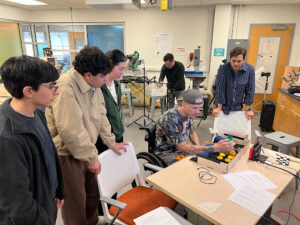
Students gather as their prototype is tested by a lived-experience expert
How does socially engaged design show up in your process?
Engineers are in the business of power transference. Not just physically. Giving somebody a tool gives them power. We have a responsibility as people who help provide power to others to make sure that we’re doing so in a way that’s responsible, not only to where we’re getting this power from, be it resources or actual energy, but also to what we’re giving somebody power to do and what they can do with that.
It’s not just about what you create, but how what you create is going to be used that you have to think about. Sometimes solving a problem isn’t a matter of something physical. Sometimes it’s a policy change, sometimes it’s a conversation or a different relationship. Not everything needs a technical solution.
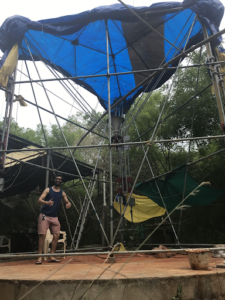
Peter in front of experimental house printer in Auroville, India
Is there a past project that made a real impact on your process as a designer?
The first time I went to India to work on a 3D printer, I spent 2 weeks trying to design the perfect nozzle to deposit this mud material. My travel partner was frustrated with how long it was taking me, went to a trash heap, took a utility knife, grabbed a bottle, cut the top and bottom off, and hose-clamped it to the end of the printer. It worked perfectly.
That’s something I try to take to my students – just try something. Just move towards reality as fast as you possibly can. If you can make it out of cardboard and masking tape, make it out of cardboard and masking tape. Make it out of trash, learn something, and have a physical relationship with it. Because you don’t know what you don’t know until you get to play with it and you get to fail.
What is a current or future project that you’re looking forward to? Or any project that gives you inspiration?
This semester, just for fun, I’ve been working on a modular adaptive gaming joystick. I’m actually working on the utility patent for it. For folks with different disability needs around joysticks, this can plug into any of the adaptive gaming systems and act as a joystick, it could act as a mouse, or a cursor on your screen.
That was inspired by the Engineering 100 section. We connected with a rehabilitation engineer and an adaptive gaming specialist, and they said that this is a huge need that’s unserved, and I thought, you know what, I can make something!

Peter’s Modular adaptive gaming controller
Finally, what is the significance of a socially engaged approach to engineering and design?
I would say that regardless of how you feel in your domain, especially being trained as an engineer, you can’t build something great and then try to find your customers. We exist in the world with people, for people. So you have to start with the people.
You don’t design in a vacuum. You are embodied in this world with the things that are on this planet that are accessible to you in this particular time and space. And that’s very unique. You are only going to be as effective as a designer as you are engaged with the people you are designing for. Users are the experts of their own lived experience.
Anything else that you’d like to share?
Just lots of credit to C-SED for continuing to foster this for me and for others. It’s an incredible space, and it adds a lot of value to the engineering program here that I think is often not seen. C-SED is an anchor to fill the gaps that the curriculum just doesn’t fill.
It’s been wonderful to be a part of that. It’s been wonderful to be active in asking where there is need in the engineering community and beyond, where students need support, need a space, need to be taught something, or be opened up to a mindset that they should have as a designer, but that they’re otherwise not exposed to.
I’m happy to be involved with a space that has dedicated itself to creating holistic engineers and holistic human beings for our students and beyond.