

Adaptive Gaming in Engineering 100: A sociotechnical introduction to design

For the estimated 20-30% of video gamers worldwide who experience some form of disability, the design of a game controller greatly impacts their ability to play and enjoy video games.
Engineering 100.230 responds to this ongoing design challenge of adaptive gaming by asking its students a core question: How can a video game controller meet the specific needs of a person with a disability?
Story by Malin Andersson-Williams
Video games offer more than an opportunity for play and relaxation. They can also combat social isolation and provide tangible ways to learn and challenge oneself physically and cognitively, impacting real lives.
Developed and taught by instructors Charlie Michaels and Philip Derbesy with Graduate Student Instructor Peter Fabe, this first-year course guides students through the accessible gaming design landscape – exploring existing technologies, learning who develops new technologies, and examining how the community incorporates these technologies into their gaming experiences.
Throughout the semester, students respond to specific user abilities and limitations such as limited mobility, range of motion, and grip strength, while considering their impact on technical and physical properties of a video game controller, like ergonomics, programming, actuation force of buttons, and control arrangements.
As they build prototypes and engage experts in both subject matter and lived experience, students consider how to approach a design challenge through a sociotechnical lens.
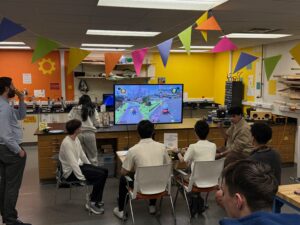
Students demo their adaptive controllers in April 2026
Taking a sociotechnical approach to engineering and design
This course is built on the fundamental acknowledgement that engineering is sociotechnical in nature – that an effective design is not just a product that functions from a technical perspective, but effectively meets the needs of the intended user.
“Engineering education can unintentionally teach that assumptions about the user can be made without consequences to the effectiveness of your design,” explains Charlie Michaels, Instructor and Managing Director of the Center for Socially Engaged Engineering & Design (C-SED). “ENGR 100.230 wants to make it clear from the very start that one element is not more important than the other – the social and the technical should be equally emphasized.”
With every exercise, whether oral, written, or technical, students learn to analyze, communicate, and discuss the tradeoffs of each decision. Across design challenges varying in the level of complexity, students must connect their design decisions to user needs, contextual factors, and accessibility considerations while clearly communicating and documenting their decisions tied to evidence.
Ultimately, this unique integration of the social and the technical into a cohesive course allows first-year students to build a comprehensive foundation of engineering as they develop into professionals.
“If students take anything away, I hope that it’s the understanding that whatever they’re doing as engineers has a broader impact, ” says Michaels. “They need to not just think about it, but actively seek out and engage with the people who experience the challenges that they’re trying to solve.”

A controller designed for a gamer with a right arm transradial amputation (below elbow), which can be played fully with one hand or with either a prosthetic hand. It features large buttons that can be easily pressed with a residual limb.

A controller designed for a novice gamer who experienced a stroke that limited movement on one side. The controller can be played fully with either hand independently or with a large external button that can be used with either hand or foot.
What is the adaptive controller project?
Throughout the semester, students dive into adaptive gaming by examining how Microsoft’s Inclusive Tech Lab considered a variety of user abilities and limitations to create the Xbox Adaptive Gaming Controller. This case study, developed by Sara Hoffman and Laura Bland at C-SED, serves as the foundation of the course project.
For ENGR 100.230 specifically, teams of three to four members develop, test, and present their own adaptive controller for Mario Kart on the Nintendo Switch, which is a popular game that already has many digital accessibility features built into the game.
Utilizing resources in the C-SED Lab, each team develops their controller with an assigned user persona in mind.
Students can reference their user’s background, motivations for wanting to play video games, past experience as a gamer, and relevant information on characteristics of the disability – including their abilities and limitations when it comes to using a standard video game controller.
The personas were co-authored with experts from the field of adaptive gaming, including a Rehabilitation Engineer and an Adaptive Gaming Specialist with lived experience as a gamer with paraplegia, who both participated actively in the course at three strategic moments: via interviews during the “Explore” stage of the process when students are first understanding the context of adaptive gaming, during the “Ideate” and “Develop” stage when students give presentations to seek feedback on their low-fidelity prototypes, and finally during “Realize” when student teams present their final projects.

Matt Zeeman, Adaptive Gaming Specialist at AbleGamers, gives feedback to a student team on their prototype of a portable, folding tabletop controller designed for an experienced gamer with a C6 spinal cord injury.
What core topics and skills are covered in Engineering 100.230?
Both individually and in small project teams, students assemble and iterate on a prototype using skills of hand building (cardboard, rigid foam, modeling clay, gluing, sketching); digital design (CAD modeling); digital fabrication (3D printing, laser cutting); and electronics (circuits, Arduino programming, soldering)
Students also practice communicating design choices through research, technical writing, proposal writing, report writing, and documenting assumptions.
Following the Socially Engaged Design Process Model, this course ultimately guides students through design thinking that integrates technical and social considerations into one cohesive course.

Students build a prototype of an adaptive controller that features a wheel

Students test the prototype of their adaptive controller
What makes Engineering 100.230 unique?
As they kick off their engineering education and careers, students in Engineering 100.230 are encouraged to consider all angles – building their ability to tackle the open-ended challenges they will face outside of the classroom.
“This course gives the students a general skill set, which, no matter what discipline they choose, will serve them,” reflects Peter Fabe, ENGR 100.230’s Graduate Student Instructor. “This skillset will allow them to talk to designers across fields, and hopefully give them a more well-rounded perspective of what their specific place is within the specific domains of engineering.”

Students test their adaptive controllers by playing a Mario Kart tournament.
Can other instructors access the open-source modules that were utilized in this course?
Engineering 100.230 leveraged content developed by the C-SED which can be accessed on the Educator Downloads page.