

Betsy Strehl | Staff Spotlight | On Engineering Education and C-SED

Betsy Strehl, PhD Candidate in Engineering Education Research at the College of Engineering, draws upon her experiences as both an educator and a student whenever she steps into a classroom.
As a Graduate Facilitator at the Center for Socially Engaged Engineering & Design, Betsy is passionate about every step of the education process – from intentionally reflecting on the scaffolding of a case study to facilitating sessions with students of various backgrounds.
Recently, Betsy met with Storyteller Malin Andersson-Williams to discuss how she found her way to C-SED, share insight into her dissertation research on the experiences of engineers who come from first-generation and lower-income backgrounds, and expand upon what influences her as a person and a designer.
What brought you to C-SED?
[Strehl] I was originally familiar with C-SED as an undergrad in biomedical engineering at U-M, during which I also had a research position with Dr. Shanna Daly, who’s one of the co-founders of C-SED!
Though I had heard of C-SED and seen it in lessons, I really didn’t understand why it was so important until I graduated and I became a teacher, teaching math and engineering in a high school setting for a few years. That’s when I started to realize that C-SED’s underlying message, which I had thought was natural or obvious in certain spaces in engineering, isn’t actually obvious to everyone in a lot of contexts.
When I eventually came back to the University of Michigan as a graduate student, I was in the Engineering Education Research Program, and given the teaching experience that I had acquired, I was encouraged to get a job at C-SED. And it just went from there!
What drew you to engineering education?
It was the realization that, after learning and experiencing engineering, I still had a lot of questions. After getting to the “real world” and seeing that those questions were still there and unanswered, it pushed me to consider how we educate engineers and prepare them for the workforce.
For me, a lot of what is missing in engineering education currently are the social factors that influence engineering design that may not always be considered in the classroom.
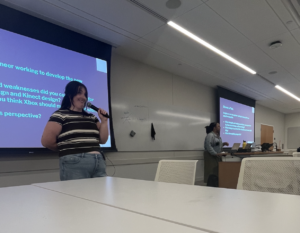
Betsy and C-SED Graduate Facilitator, LaTara, leading a new workshop about the Xbox Adaptive Controller and Design Accessibility
When you first encountered a socially engaged approach to design and engineering, what motivated you to engage with it further?
I saw it in action for the first time after graduation when I was teaching math for a few years in a rural school in New Mexico. I was asked to develop engineering courses for a Project Lead the Way curriculum but had absolutely no budget, so I had to do a lot of community-based and participatory learning. In utilizing a lot of the more community-engaged aspects of socially engaged design, I was finally able to apply the principles that were taught to me and see the positive response.
My students really responded well to taking the time to understand principles by integrating them into their understanding of design, as well as to getting their families involved. I was piloting a class, so there were obviously things that went well and things that did not go well, but I think just getting to see what it would look like in a real-world context was really great for me.
What is a project or experience that impacted your process as a designer, facilitator, and/or educator?
When I first started graduate school, I worked with the SHUTTLE Lab studying students’ perceptions of ethical dilemmas in aerospace. That project was really illuminating for me, because, although I know that no one thinks the same, being able to visualize the breadth of how students navigate challenging topics was really, really interesting to me.
With ethical issues, there are always a wide range of feelings and experiences in a classroom, but students are not necessarily comfortable sharing them. Understanding that students feel the conflict between the social and the technical, and that students do need this education, was very grounding for me. This is needed because if we as engineers are not providing this guidance on how to navigate these nuanced and complex situations, who is?
What is the value in integrating both social and technical considerations in the classroom?
When the professional and social skills of engineering are not prioritized in the classroom, you never know where students are, if at all, developing them. By offloading that responsibility outside of the class, it’s disadvantageous to groups that might not be able to get those opportunities outside of the classroom through extracurriculars. This continues to separate the role of engineers in society and offloads decision-making roles onto people who don’t know the full implications of some of the technology or innovations that we’re working with.

Betsy along with other members of her research group, the SHUTTLE Lab. (L to R: C-SED facilitator Kemi Johnson, Betsy Strehl, Dr. Aaron Johnson, Em Buten, and Nataly Cortez
What is a current project or experience that is inspiring you as a designer, a facilitator, an instructor, or as an individual?
A lot of my dissertation involves working with students who don’t always get their voices heard, and that is something that really motivates me. It’s been really inspiring to be able to take what I hear from these students and bring it to other people. My goal is that the cross-pollination and the connections keep happening, because I think that we truly have almost all of the resources and talent we need at this institution. It’s a matter of connecting the right people and resources.
Which case studies or design sessions have you particularly enjoyed as a Graduate Facilitator?
For the design skill sessions, idea generation, stakeholder mapping, and prototyping are fun because students try to get as creative as possible.
I really enjoyed teaching the Hurricane Katrina case study with Nolgie Oquendo-Colón. Nolgie is from Puerto Rico and has lived through several hurricanes firsthand, so he was able to contribute a unique perspective that most in the classroom didn’t have. When we were together, he’d explain how fast flash floods really happen, which helped contextualize the severity of the situation to students in a way that some Hurricane Katrina artifacts cannot.
What have you enjoyed about working with C-SED? What have you enjoyed about being a graduate facilitator?
Honestly, I think just working with the students has been such a pleasure. They’re so creative, whether or not they know that. It’s really interesting to hear what they have to say, especially in what I call the “hear-me-out moments” when students have to convince me why an idea or topic connects back to the lesson. Those are my favorite moments, because I do believe the learning is happening.
I also enjoy working with the staff. I really appreciate that when they come to meetings, they genuinely want to make sure that the lessons are not only aligning with the mission of C-SED, but also resonating with students.
Connect with Betsy via LinkedIn to discuss anything engineering education — teaching, participatory research methods, and minoritized student experiences in engineering in particular.